Custom Runner Rugs: How Seraj Rugs Fits Stairs and Hallways
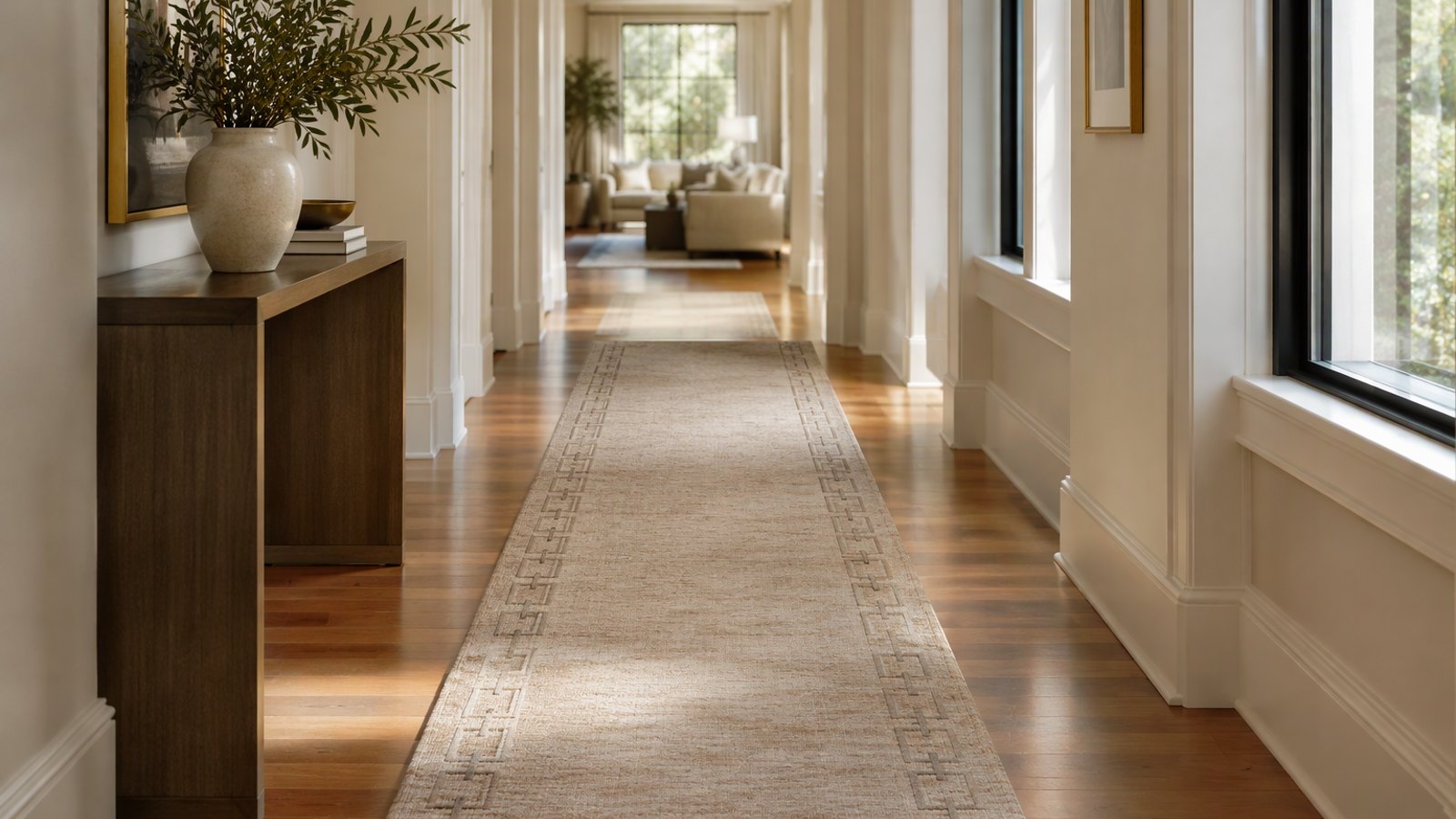
Custom Runner Rugs: How Seraj Rugs Fits Stairs and Hallways

In short
- A runner is any long, narrow rug; stairs and hallways almost always need a size no off-the-shelf runner offers.
- For a stair runner, measure one step (tread plus riser), multiply by the number of steps, then add length for the nosing wrap and waste.
- For a hallway runner, measure the full length wall to wall and leave an even reveal of floor on each side.
- We weave to the exact dimensions you send, so the runner fits the space rather than forcing the space to fit the rug.

What custom runner rugs are, and why runner rugs go custom
A runner is simply a long, narrow rug, usually two to three feet wide and anywhere from six to twenty feet or more in length. Stairs and hallways are the two places where runner rugs earn their keep, and they are also the two places where fixed sizes let you down. Every staircase has its own step count, tread depth and width. Every hallway has its own run between the walls and its own doorways. The chance that a stock length lands exactly right is small, which is why we make custom runner rugs to order.
Going custom covers more than length. It lets you set the width to leave a tidy reveal of floor on each side, choose a construction that stands up to foot traffic, and carry one design through from the hall into the stairs so the two read as a set. For partners fitting a whole home or a hospitality project, that consistency is the point.
How to measure a custom stair runner
A custom stair runner follows the shape of the steps, so the measurement wraps over each tread and down each riser. Here is the method we ask partners to use before they send dimensions.
- Measure the depth of one tread, the flat part you step on, from the front edge to the back.
- Measure the height of one riser, the vertical face between steps.
- Add the tread and riser together to get the length used by a single step.
- Multiply that figure by the number of steps in the flight.
- Add roughly two to three inches per step so the runner can wrap over each nosing, the lip at the front of the tread.
- Add a little extra length overall for trimming and fitting, then measure the width of the stairs to set the runner width.
For width, decide whether you want the runner to run the full width of the steps or to sit centered with an even band of bare tread showing on each side. A centered runner usually leaves three to six inches of wood on each side. Landings count too: measure any landing as a flat section and add it to the total length. If your stairs curve or wind, measure each step on its own, because the tread depth changes across a turn.
How to measure a custom hallway runner
A custom hallway runner is more straightforward than a stair runner because the floor is flat, but the same two questions decide the size: how long, and how wide.
- Measure the full length of the hallway floor from wall to wall, or from the point where you want the runner to start to where you want it to end.
- Decide on an end gap. Leaving four to eight inches of floor before each wall or doorway stops the runner from crowding the thresholds; running it the full length is also fine if you prefer wall to wall.
- Measure the width of the hallway, then subtract an even reveal of floor on each side, usually three to five inches per side, to get the runner width.
- Note any doorways, radiators or fixed furniture along the run, since these affect where the runner should stop.
As a quick reference, here is how common hallway widths translate into a runner width once you allow for a reveal on each side.
| Hallway width | Reveal per side | Suggested runner width |
|---|---|---|
| 36 in (3 ft) | 4 in | 28 in |
| 42 in (3.5 ft) | 4 in | 34 in |
| 48 in (4 ft) | 5 in | 38 in |
| 60 in (5 ft) | 5 in | 50 in |
These are starting points, not rules. Send us the raw hallway measurements and we will confirm a width that suits the space and the design.
Fitting a stair or hallway runner?
Contact us
How we weave your runner rugs
We are a manufacturer, not a reseller, which is what makes a true made-to-size runner possible. We run our own looms in Nepal and India, with around 200 looms and roughly 500 weavers across the two workshops, so the length and width you send become the length and width we set on the loom. There is no cutting down a larger rug and binding the edge; the runner is woven to your dimensions from the first knot.
Partners can pick a construction to match the traffic. A hand-knotted wool runner is dense and hard-wearing for a busy staircase, while a hand-tufted runner is a good fit where budget and lead time matter more. You send the measurements, the design or a reference, and the palette; we sample it, then weave the run. Because the design is set in the file, a hallway runner and a matching stair runner come off the loom as a pair.
When a custom runner beats a standard size
Standard runner rugs work when the space happens to match a stock length, which is rare on stairs and uncommon in halls. A standard runner that is a foot short leaves the end of the hall bare; one that is a foot long has to be turned up against a door or wall. On stairs the problem is sharper, because a runner that does not match the step count either runs out partway up or overshoots the top.
A custom runner avoids both. You get the exact length for the number of steps or the run of the hall, the width that leaves the reveal you want, and a construction chosen for the traffic the floor sees. For a single home that means a runner that looks made for the space, because it was. For a trade or hospitality project it means every floor matches the spec rather than the nearest size in stock.
Frequently asked questions
How do I measure for a custom stair runner?+
What width should a custom hallway runner be?+
Can you match a stair runner to a hallway runner?+
What is the best construction for a stair runner?+
Do custom runner rugs cost more than standard ones?+
How long does a custom runner take to make?+
Related guides and pages
Fitting a stair or hallway runner?
Send us the step count or the hallway run and we will weave a runner to the exact length and width you need, in your design and palette.
Contact us