Geometric Rugs By Seraj Rugs: Custom Rugs
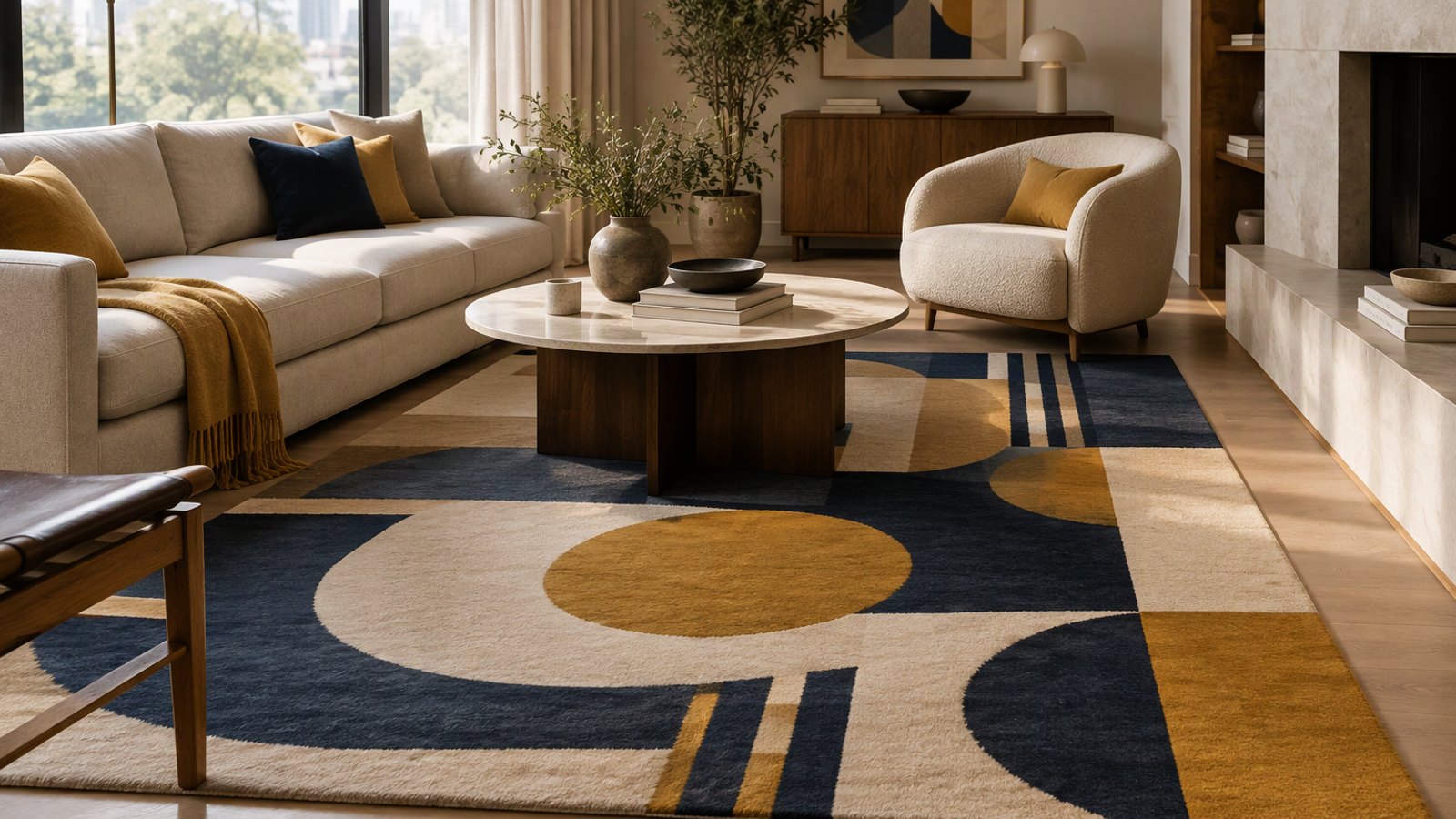
Geometric Rugs: Bauhaus and Art Deco Patterns, Woven Custom

In short
- Geometric rugs cover a wide family, from strict Bauhaus grids to the fans and chevrons of Art Deco.
- Bauhaus rugs favor primary color blocks and right angles; art deco rugs lean on curves, rays, and a sense of occasion.
- Weaving a geometric rug custom lets you match the pattern scale to the room instead of forcing the room to fit the rug.
- You can tell a hand-knotted geometric rug from a tufted one by reading the back, and we explain how below.

What makes a rug geometric
A geometric rug is built from shapes and lines rather than flowers, vines, or scenes. Squares, triangles, diamonds, chevrons, grids, concentric rings, and interlocking blocks all count. The appeal is that geometry reads as modern at almost any scale: a fine grid can feel quiet and architectural, while a large block pattern becomes the main event of a room. Because the structure is mathematical, geometric rugs translate cleanly from a drawing to a woven piece, which is part of why they suit custom work so well. We map a repeat onto the loom, set the knot count, and the pattern holds its proportions across the whole rug.
Two design movements shaped most of the geometric language used today. The modern grids people reach for owe a lot to the Bauhaus, and the glamorous, curved geometry in hotels and period interiors comes from Art Deco. Knowing which one a project is leaning toward makes the color, scale, and construction choices much easier.
Bauhaus rugs: geometry stripped to the essentials
Bauhaus rugs take their cue from the German design school that treated form as a result of function. The vocabulary is spare: primary colors, true black and white, right angles, and off-set blocks that feel balanced without being symmetrical. A Bauhaus pattern rarely repeats in a predictable grid; instead it arranges a few strong shapes so the eye keeps moving. On the floor this reads as calm and deliberate, which is why bauhaus rugs sit so well under mid-century and contemporary furniture.
For weaving, the clean edges of a Bauhaus design reward a tighter construction. Hard color boundaries look crisp in a hand-knotted rug and can be softened or sharpened in a minimal tufted piece, depending on the look you want. We keep the palette flat and the lines true to the drawing so the geometry does the work.
Art deco rugs: pattern with a sense of occasion
Art deco rugs come from a different instinct. Where Bauhaus strips things back, Art Deco adds: sunburst fans, stepped pyramids, scallops, and sweeping curves, often in deeper tones with a metallic or jewel accent. The style peaked in the 1920s and 1930s and still signals glamour, which is why art deco rugs turn up in hospitality lobbies, bars, and statement living rooms. The geometry is still precise, but it is dramatic rather than quiet.
These patterns ask more of the weave. Curves and radiating lines need enough knot density to stay smooth rather than stepped, so Art Deco work often goes on our finer hand-knotted looms. If a project wants the drama without the depth, an abstract treatment of the same motifs can keep the movement while loosening the rules.
Have a geometric pattern in mind?
Contact us
Choosing geometric patterns for modern interiors
The quickest way to narrow a brief is to decide whether a room wants quiet structure or a statement. Bauhaus leans quiet; Art Deco leans statement. The table below lines up the two so you can match a style to the space.
| Cue | Bauhaus rugs | Art deco rugs |
|---|---|---|
| Shapes | Blocks, squares, right angles | Fans, scallops, stepped curves |
| Color | Primaries, black, white | Jewel tones, deep neutrals, metallic accent |
| Mood | Calm, architectural | Glamorous, dramatic |
| Best under | Mid-century, contemporary pieces | Hospitality, period, statement rooms |
| Weave that suits it | Minimal tufted or hand-knotted | Finer hand-knotted |
In an open-plan home, a geometric rug is also a quiet way to zone a space: a grid under the seating and a plainer runner in the hall will read as one family without matching exactly. When the room sits between standard dimensions, weaving to measure pays off, and our custom size work means the pattern repeat is set for your floor rather than cropped to fit it.
How we weave geometric rugs custom, knot by knot
Most of the geometric rugs we produce begin as a designer's file: a flat drawing, a render, or a photo of an inspiration piece. We translate that into a weaving map, agree the construction and palette, and sample a strike-off before we run the full size. Because we own the looms, there is no size penalty for a geometric rug that does not match a standard dimension, and the pattern proportions stay true from corner to corner.
How to tell if a rug is hand knotted
Buyers often ask how to tell if a rug is hand knotted, and the back of the rug gives the clearest answer. On a hand-knotted rug the pattern on the underside mirrors the top almost exactly, because the design is formed by thousands of individual knots tied around the warp. The knots are slightly irregular, and there is no separate backing cloth glued on. Fold the rug and you will see rows of knots at the base of the pile. A hand-tufted rug, by contrast, is made by punching yarn through a backing with a tool, so the reverse is covered by a canvas scrim and a layer of latex, and the design does not show through cleanly. Machine-made rugs look perfectly uniform front and back and often have a serged or overlocked edge rather than a hand-finished one. None of these methods is wrong; they simply suit different budgets and uses, and we weave both hand-knotted and hand-tufted geometric rugs.
Scale, color, and getting the proportions right
Geometry is unforgiving about scale, so it is worth deciding early. A small repeat in a large room can look busy from across the space, while an oversized block pattern in a small room can feel heavy. As a rule, let the shapes relate to the furniture: a grid roughly the width of a sofa cushion tends to read well, and a large statement shape wants room to breathe on at least two sides.
Color is the other lever. A two-tone geometric rug will always feel more modern and more flexible than a many-colored one, and it is easier to live with as a room changes. If a project needs the pattern but not the contrast, we can hold the geometry and bring the palette down to tone-on-tone, which keeps the contemporary feel without shouting. Send us the room, the palette, and the look you are after, and we will sample it before anything is committed to the full loom.
Frequently asked questions
What are geometric rugs?+
What is the difference between Bauhaus rugs and art deco rugs?+
Can I get a geometric rug in a custom size and color?+
Are geometric rugs good for modern interiors?+
How can I tell if a geometric rug is hand knotted?+
Do you weave geometric rugs in hand-knotted and hand-tufted?+
Related collections and guides
Real places to explore patterns and start a custom geometric rug.
Have a geometric pattern in mind?
Pick from the design library or send us a sketch, render, or palette, and we will weave your geometric rug to size on our own looms.
Contact us