Hand-Knotted vs Hand-Tufted vs Handwoven Rugs | Seraj Rugs
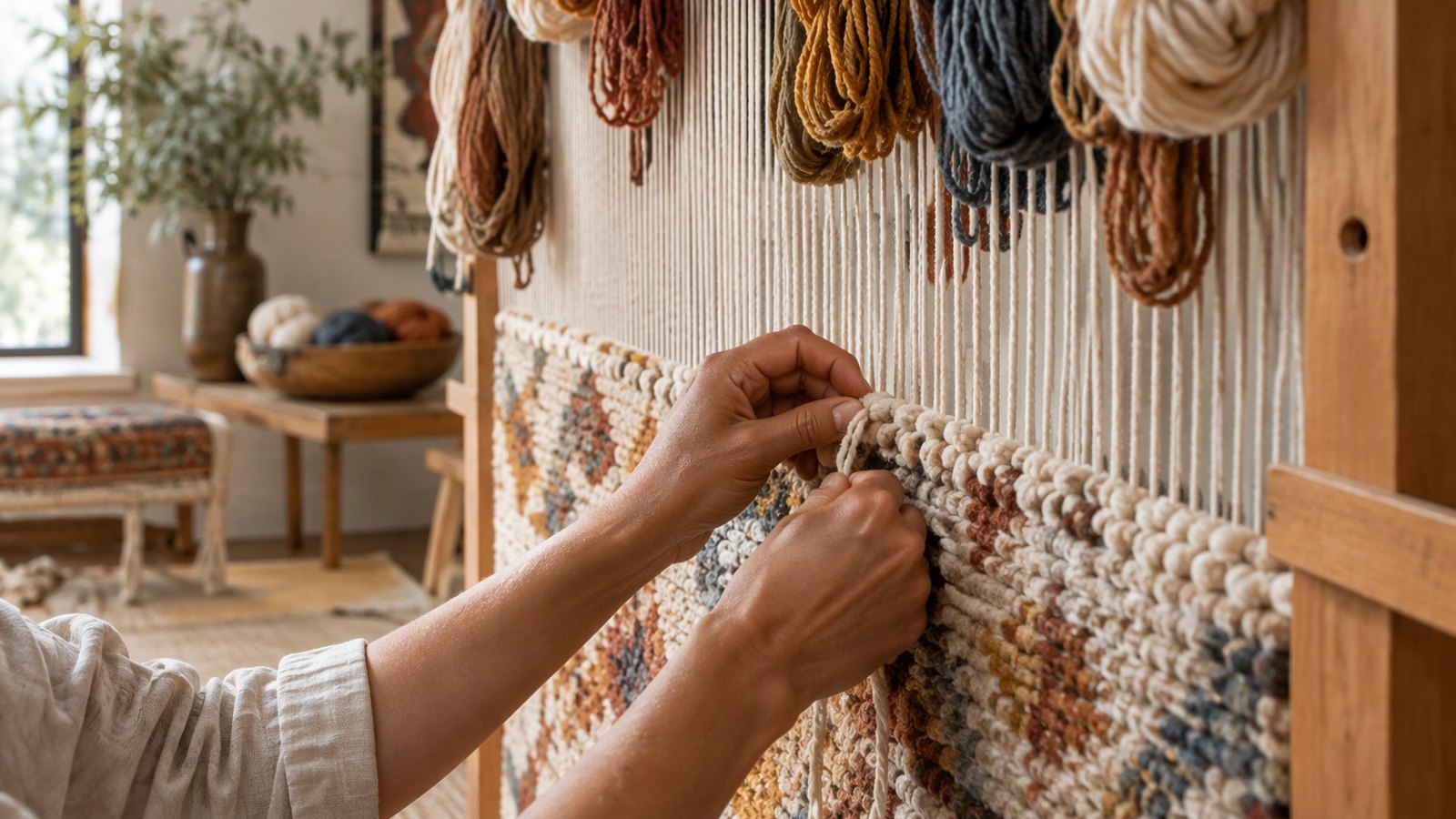
Hand-knotted, hand-tufted or handwoven?

In short
- Hand-knotted vs hand-tufted comes down to speed and purpose: knotting is the slowest and most durable, tufting is faster and suits bold custom color over large areas.
- Hand-knotted rugs hold the finest detail and last for generations, which is why they are the heirloom choice.
- Handwoven flatweave rugs carry no pile, so they are light, reversible and ideal for layering and lighter-traffic rooms.
- We weave all three in-house, so we route each piece to the construction that fits its design, budget and wear.

Hand-knotted vs hand-tufted vs handwoven: the short version
Every rug we make falls into one of three constructions, and most of the confusion around rug construction comes from mixing them up. Hand-knotted rugs are tied knot by knot on a loom. Hand-tufted rugs are punched into a stretched canvas with a tufting tool. Handwoven flatweave rugs are woven flat with no pile at all. The hand-knotted vs hand-tufted question is the one partners raise most, because the two can look similar in a photo while being built in completely different ways and priced on completely different amounts of labor.
The honest way to choose is to start from the job. A fine detailed design that has to last decades points one way. A bold block of custom color across a large floor points another. A light, reversible rug for layering points to flatweave. Below we break down how each is made, how long it takes relative to the others, the detail it holds, how it wears, and where it belongs.
Hand-knotted: the slowest build and the longest life
A hand-knotted rug is tied one knot at a time. A weaver works across a vertical loom, wrapping yarn around the warp threads and securing each knot by hand, then beating down the weft and shearing the pile level as the rug grows row by row. Nothing about it is quick. It is by far the most labor-intensive of the three, and a single fine piece can occupy a weaver for months, so lead times run longer than any other construction we offer.
What that labor buys is resolution and durability. Because the design is built knot by knot, the surface can carry very fine detail, tight curves and subtle color shifts that the other methods cannot match. Higher knot counts mean more detail and a denser, harder-wearing pile. The knots are locked into the foundation rather than glued to it, so a well-made hand-knotted rug can be used for generations and is fully repairable. It reads the same from the back as the front, with the design visible in the knots on the reverse, which is one of the quickest ways to tell a knotted rug from a tufted one.
Best for
- Heirloom and investment pieces meant to last decades.
- Fine, detailed and intricate designs that need high resolution.
- High-traffic floors and hospitality work that has to stay the course.
- Projects where repairability and long life matter more than speed.
See the range on our hand-knotted collection, and our deeper note on hand-knotted wool rugs.
Hand-tufted: faster, and built for bold custom color
A hand-tufted rug is made by punching yarn through a canvas backing stretched on a frame. The maker follows the design drawn on the canvas and works a handheld tufting tool to push loops of pile through it. Once the surface is filled, the back is coated to lock the yarn in place and a secondary backing is added, then the pile is sheared to an even height. It is a hand process, but a much faster one than knotting, so it is less labor-intensive and turns around on shorter lead times.
That speed is the point. Hand-tufting lets us cover large areas and realize bold, graphic designs and strong custom color without the time a knotted rug would take. It handles broad fields of color and clean shapes very well. The trade-off is in fineness and lifespan: tufted rugs hold good but not knot-level detail, and because the pile is set into a backing rather than tied into the foundation, they are not reversible and will not match a hand-knotted rug for decades of heavy wear. For many rooms and projects that is exactly the right balance.
Best for
- Bold, graphic and large-scale custom designs.
- Strong blocks of color across wide floor areas.
- Projects on a shorter timeline or a tighter labor budget.
- Medium-traffic residential and commercial spaces.
See our hand-tufted collection for the kind of work this construction suits.
Not sure which construction fits?
Contact us
Handwoven flatweave: light, low pile and reversible
Flatweave rugs are handwoven, which in rug terms means woven flat on a loom with the weft passed over and under the warp, so there is no knotted or tufted pile standing up from the surface. Kilims and dhurries are the familiar examples. Because the structure is the surface, a flatweave is thin, light and reversible, with the pattern showing on both faces. It usually weaves faster than a knotted rug of the same size, though fine tapestry-style flatweaves can take real time.
Flatweaves suit a different set of jobs. They are easy to lift, turn and move, which makes them the natural choice for layering over a larger rug or over hard floors. Their low profile sits well under doors and in passages where a thick pile would not. They are durable in their own way and simple to clean, but they give you none of the softness underfoot that a pile rug does, and very fine pictorial detail is harder to achieve than in a knotted piece. Think of them as the light, flexible, low-pile option rather than a thinner version of a pile rug.
Best for
- Layering over larger rugs or over hard floors.
- Lighter-traffic rooms and spaces that need a low profile.
- Reversible rugs that can be turned to even out wear.
- Designs built on pattern and color rather than deep pile.
Rug construction compared at a glance
The table below sets the three side by side. Treat it as a general guide to rug construction rather than a hard rule, since a design can often be adapted across methods and we make all three in-house.
| Construction | How it is made | Detail | Durability | Best for |
|---|---|---|---|---|
| Hand-knotted | Each knot tied by hand into the foundation on a loom | Finest, high resolution; rises with knot count | Highest; repairable and good for generations | Heirloom pieces, fine detail, high-traffic floors |
| Hand-tufted | Yarn punched through a backing with a tufting tool, then coated | Good; strong at bold shapes and color blocks | Solid for medium traffic; not reversible | Bold custom color, large areas, shorter timelines |
| Handwoven flatweave | Woven flat, weft over warp, with no standing pile | Pattern-led; fine pictorial detail is harder | Durable and reversible; low pile | Layering, low-profile spaces, lighter traffic |
Weight and feel track the method too: hand-knotted sits dense and substantial, hand-tufted is softer and plush underfoot, and flatweave is the thinnest and lightest of the three.
How we help a partner pick
In practice the choice is rarely about which construction is finest in the abstract. It is about matching the method to the design, the floor it will live on, the timeline and the budget. A detailed design meant to last decades wants hand-knotted. A bold graphic in strong color across a wide floor, needed sooner, suits hand-tufted. A light, reversible layer or a low-profile runner points to flatweave. Plenty of projects use more than one.
Because we own the looms for all three, the routing is ours to manage and the advice is not tied to selling one method. Partners send us a design, a render or a brief with sizes and the wear the rug has to take, and we say which construction fits and why before anything is woven. If a program needs a knotted hero piece and a set of flatweaves, we make both and run it as one order. When you are weighing hand-knotted vs hand-tufted for a specific piece and want a straight recommendation, send it over through our custom rugs service and we will walk you through it.
Frequently asked questions
What is the main difference between hand-knotted and hand-tufted rugs?+
Are handwoven flatweave rugs durable?+
Which rug construction holds the finest detail?+
Is a hand-tufted rug worth it compared to hand-knotted?+
How can I tell a hand-knotted rug from a hand-tufted one?+
Do you make all three constructions in-house?+
Related pages and collections
Not sure which construction fits?
Send us the design, the sizes and the floor it will live on, and we will tell you whether hand-knotted, hand-tufted or flatweave is the right build before we weave a thing.
Contact us