Nepal Handmade Rugs: What Makes Seraj Rugs Stand Out
Nepal Handmade Rugs: What Makes Seraj Rugs Stand Out


In short
- We run our own looms in Nepal, so nepalese rugs are made in-house, not brokered.
- Hand-spun, hand-carded Tibetan highland wool gives our nepal wool rugs their handle and wear.
- Every piece is hand-knotted to an agreed knot count, with the construction locked before we start.
- We send a physical strike-off so partners approve color, pile, and quality before the full order runs.

Why Nepal is where our work shows best
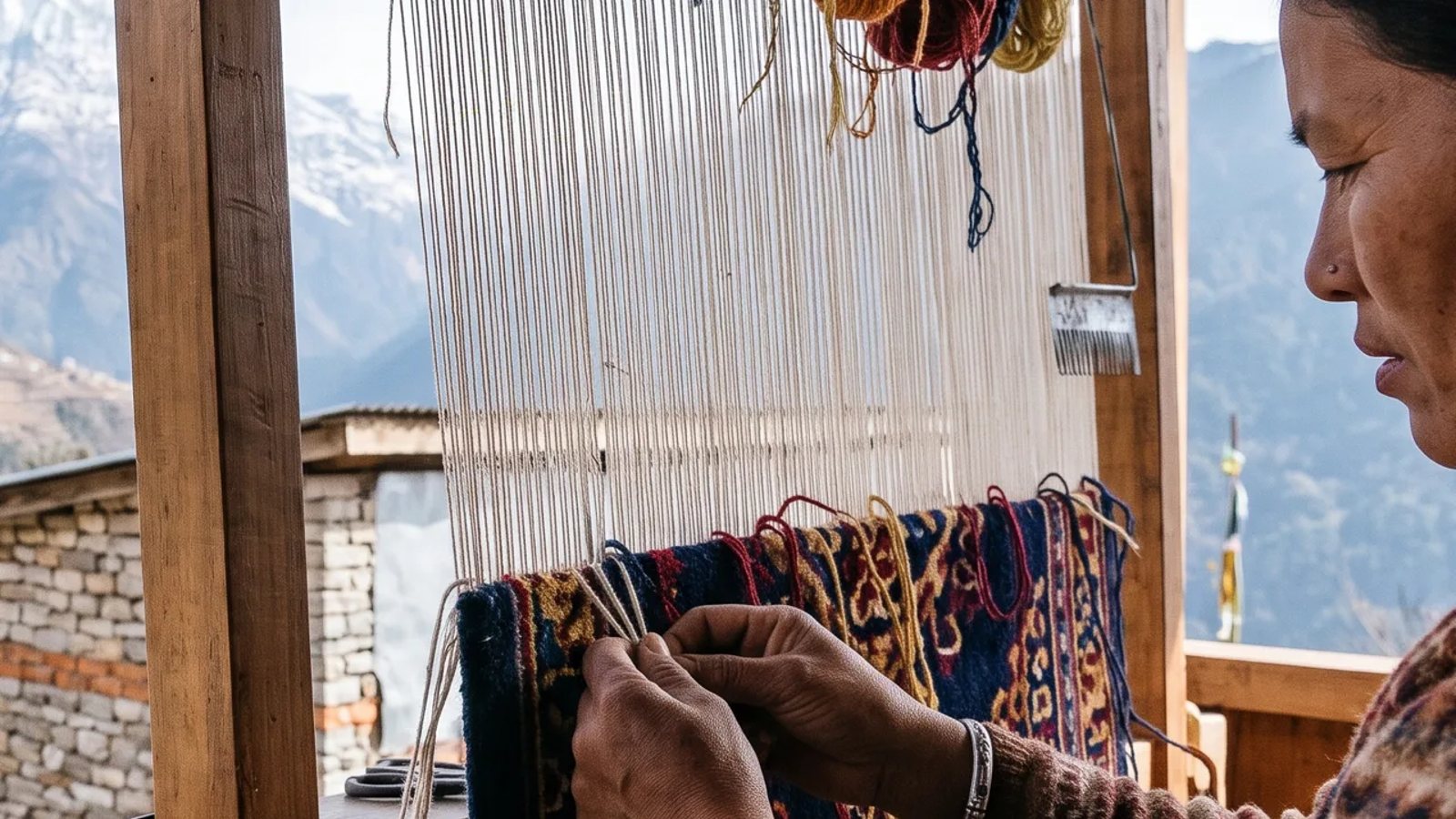
Nepal is our strongest search visibility for a reason: it is where our hand-knotted program is deepest. Carpets from Nepal carry a long weaving tradition brought over the Himalaya, and we build on it with scale and control. Across our looms we run roughly 200 looms with about 500 weavers, which lets us hold one standard of quality from a single rug through a hospitality run. That combination, a craft base plus real capacity, is why nepalese rugs are the heart of what we make.
Being the maker is the whole point. We are not placing your order with a workshop we have never visited. The loom is ours, the weavers work with us directly, and the person you talk to can walk to the frame your rug is on. When something needs to change mid-run, it changes, because there is no broker in the middle translating your note into someone else's priority.
Our own looms, not a sourced supply chain
A lot of rugs sold as Nepal handmade are brokered: a trader takes an order, farms it out, and ships whatever comes back. We do the opposite. We own the production, so the quality you approve is the quality that runs, and the lead time we quote is the lead time we control. For interior designers and importers, that means fewer surprises between the sample and the container.
What direct manufacturing changes for partners
- One point of accountability from brief to delivery, not a chain of hand-offs.
- Consistency across a large run, because the same looms and weavers make every piece.
- Honest lead times, since we schedule our own capacity rather than wait on a third party.
- Changes mid-project handled at the loom, not renegotiated through a trader.
Hand-spun Tibetan wool
The handle of a rug starts with the wool, long before the knot. Our nepal wool rugs use Tibetan highland wool, which is prized for a high lanolin content that gives it luster and resilience. We keep the wool hand-spun and hand-carded rather than machine-processed, so the yarn holds small natural variations that make a hand-knotted surface read as handmade instead of flat and uniform.
That wool choice is also a wear choice. A dense, springy pile from good highland wool takes foot traffic and recovers, which matters as much to a hotel corridor as it does to a living room. We can blend in silk or other fibers where a design calls for sheen, but wool is the backbone of our Nepal program.
See the loom for yourself
Contact us
The hand-knot, and the knot count we agree
Hand-knotting is slow, and that is the value. Each knot is tied by hand around the warp, row by row, which is what lets a weaver follow a detailed design and build a pile that lasts for decades. We agree the knot count with you up front, because knot count drives both the detail a design can carry and the density underfoot. A geometric modern piece and a fine traditional pattern are not the same build, and we spec them differently on purpose.
Because we are the maker, the construction is a decision we make together rather than a fixed menu. You tell us the look, the room, and the wear it needs to take, and we set the knot count, pile height, and wool blend to match. Our hand-knotted collection and our modern range both come off this same disciplined process.
The strike-off: approve before we run
This is the promise that ties it together. Before any order goes into full production, we weave a strike-off, a physical sample of your actual rug, in the real wool, colors, and construction. You hold it, check the color against your scheme, feel the pile, and approve it. Nothing runs at scale until that sample is signed off.
A strike-off removes the biggest risk in buying handmade rugs from a distance: ordering from a screen and hoping the finished piece matches. For trade partners placing larger orders, it is the difference between a hopeful guess and a controlled decision. Send us a design or pick from our library, and the strike-off is the step where the rug stops being a render and becomes real.
How to work with us on a Nepal order
Starting is simple. Partners send a brief, a render, or a pointer to a design in our library, along with sizes and the wear the rug needs to handle. We confirm the construction, weave a strike-off, and once it is approved, we schedule the run on our looms. For anything off-standard, we weave to the exact dimensions you give us, so a room that falls between common sizes still gets a rug that fits.
If you want to see the process rather than read about it, we will put a loom on a live call so you can watch the knotting and ask questions in real time. It is the clearest way to understand why nepalese rugs made this way hold up.
Frequently asked questions
What makes Nepal handmade rugs different from other handmade rugs?+
Are your nepalese rugs made in your own facility?+
What wool do you use in your nepal wool rugs?+
What is a strike-off and why does it matter?+
Can I order custom carpets from Nepal in a non-standard size?+
Can I see the rugs being made?+
Related pages and collections
See the loom for yourself
Book a live loom call and watch your rug being hand-knotted in Nepal, or send us a brief and we will start with a strike-off.
Contact us