How a Painting Becomes A Rug | Seraj Rugs
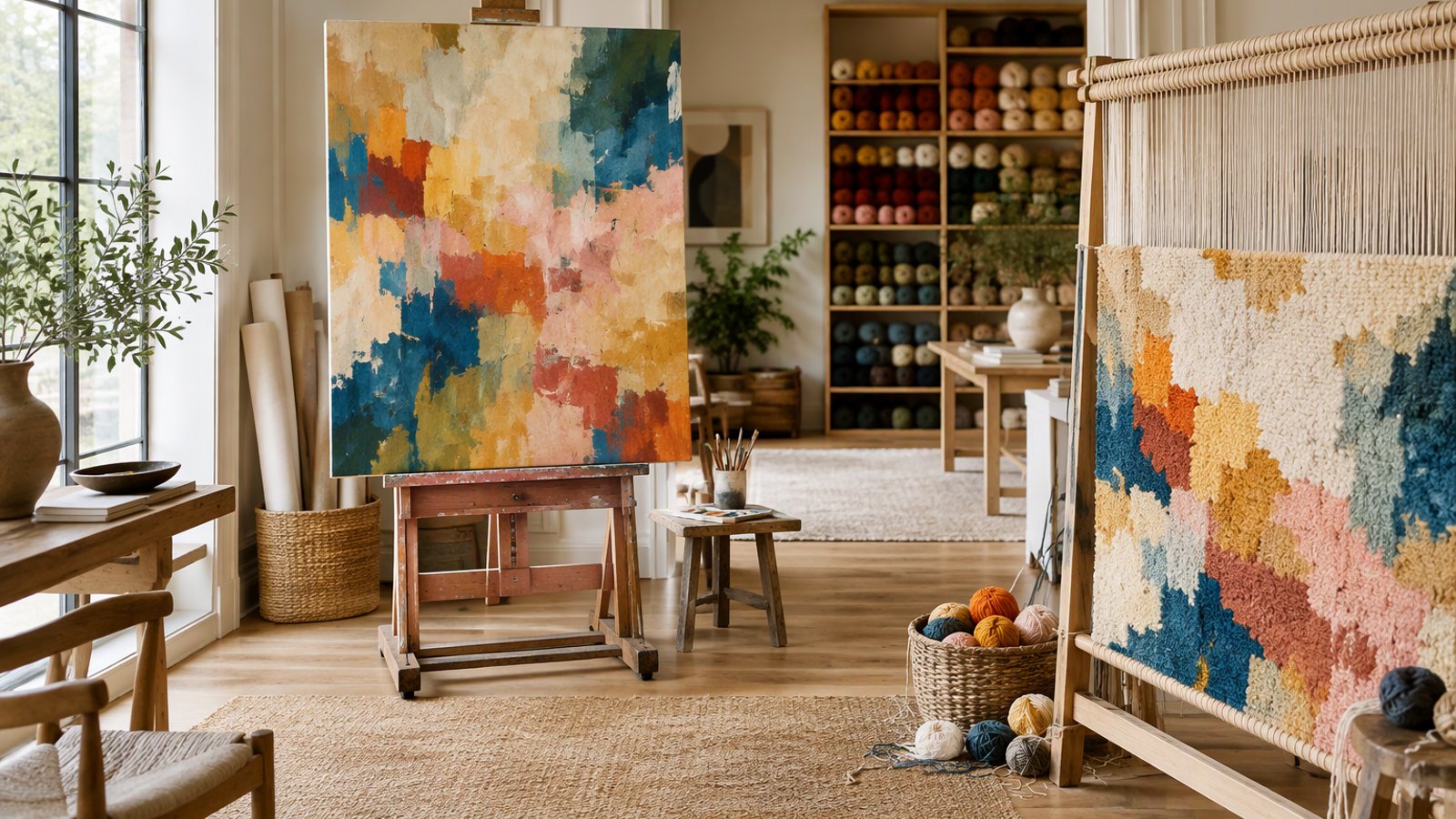
How a painting becomes a rug

In short
- A custom rug design begins by reading the artwork and deciding what detail, color and mood can carry into a knotted pile.
- We reduce the painting to a dyeable palette, then dye yarn to match each color by hand before any weaving starts.
- The image is mapped onto a knot grid at a chosen knot count, which sets how much fine detail the rug can hold.
- A strike-off sample is woven and signed off first, so the full rug is only made once the color and detail are approved.

Reading the artwork: what survives the move to pile
Every custom rug design starts with a long look at the source. Before we talk about looms or knots, we read the painting the way a weaver will have to read it: as areas of color, edges, and texture rather than brushstrokes. A painting lives in thin layers of pigment on a flat surface. A rug lives in thousands of short lengths of dyed yarn standing on end. Those are different materials, and part of our job is to say honestly what moves well between them and what does not.
Broad fields of color, strong shapes, gradients and bold composition translate beautifully into pile. Very fine hairline detail, tiny text, and photographic micro-texture are harder, because the smallest unit a hand-knotted rug can show is a single knot, not a pixel. So when a partner sends us an artwork to turn into a rug, our first response is a read of it: here is what will sing in wool, here is where we will simplify, and here is where a higher knot count will buy back detail. Getting that conversation done early is what keeps the finished rug faithful to the intent of the piece rather than a rough echo of it.
We also ask what the rug is for. A hand-knotted floor piece that will take daily traffic is read differently from a wall hanging. The wear, the size, and the room all feed back into how literally we can follow the painting.
From painting to palette: reducing colors and dyeing to match
A painting can hold thousands of shades that blend continuously into each other. A rug is built from a finite set of dyed yarns. The second step in any custom rug design is reducing the artwork to a palette we can actually dye and weave, usually somewhere between a handful and a few dozen colors depending on the piece.
Reducing the palette is a craft decision as much as a technical one. We group close shades, decide where a gradient should be held by a few stepped tones and where it needs more, and protect the two or three colors that carry the whole mood of the painting. Lose those and the rug stops feeling like the artwork, even if every other color is right.
Dyeing yarn to the painting
Once the palette is set, we dye yarn to match each color by hand. Our weaving leans on hand-spun wool and, where a design needs extra sheen, silk blended into the pile. Natural fibers take dye with small variations that give a knotted surface its depth, so we dye against a physical reference and check the hanks in daylight rather than trusting a screen. If a color is off, we redye before a single knot is tied. Matching a painter's exact blue or a photograph's warm gray is routine work for us, but it is work that happens here, at the yarn stage, not later.
Mapping the image onto the knot grid
A hand-knotted rug is a grid. Each knot sits at one intersection of warp and weft, so the whole image has to be rebuilt as a map that tells the weaver which colored knot goes where, row by row. This map is the graph, and building it is where the painting truly becomes weaveable.
We lay the artwork over a grid sized to the chosen knot count and the finished dimensions, then resolve every square to one of the palette colors. Curves become stepped, soft edges get a decision about how sharp or how blended they should read, and the whole composition is checked at true size so nothing that looks fine small gets lost large, or the reverse. The denser the grid, the more faithfully a curve or a fine gradient can follow the original.
- The knot count sets the grid: more knots per unit area means more squares to carry detail.
- Each square is assigned one dyed color from the approved palette.
- Gradients are resolved into stepped bands or fine dithering, depending on the look we want.
- The graph is scaled to the exact finished size so the weaver works at a one to one map.
This is also where we confirm that the custom rug design holds together at the size and construction a partner actually needs. The same artwork mapped for a small fine piece and for a large room-sized rug produces two different graphs, and we build the one that suits the order.
Have an artwork you want underfoot?
Contact us
The strike-off: proving the design before the full run
We do not weave a full rug from a graph and hope. We weave a strike-off first. A strike-off is a sample panel woven from the real graph, in the real dyed yarn, at the real knot count, so a partner can see and touch how the design actually comes out in pile before the whole piece is committed.
The strike-off is where color, scale and detail get signed off. A blue that looked right as a dyed hank reads differently once it is knotted next to its neighbors, and an edge that seemed sharp on the graph shows its true softness in wool. Partners review the strike-off, call any changes, and we adjust the palette or the graph and, if needed, weave again. Nothing goes to the full loom until that sign-off is done.
This step is the difference between a controlled custom rug design and a gamble. It costs a little time up front and removes almost all the risk from the main weave, because by the time the full rug is on the loom, every decision in it has already been seen and approved.
Weaving, washing and finishing
With the strike-off approved, the full rug goes onto the loom. Weavers work the graph row by row, tying each knot by hand against the map and the dyed yarn. A large or fine piece can hold an enormous number of knots, and the same hands stay with the rug so the tension and the reading of the graph are consistent from the first row to the last. We run roughly 200 looms with about 500 weavers, which lets us hold one standard across a piece and keep a program of pieces matched to each other.
After the loom
Weaving is not the last step. Once a rug is off the loom it is washed, which settles the pile, brings out the luster of the wool and silk, and sets the color. Then it is stretched and trued so it lies flat and square, the pile is clipped to an even height, and the edges and ends are finished by hand. Washing in particular changes how a rug looks, softening and deepening the colors, which is another reason the strike-off matters: we are judging color as it will be after the wash, not as raw knots.
The result is a piece that carries the painting in a material the painting never had. The same composition now has the weight, the pile and the quiet sheen of a hand-knotted rug, and it will wear in rather than out.
How detail scales with knot density
The single biggest lever on how much of a painting a rug can hold is knot density. The grid is the resolution of the rug, so a higher knot count gives you more squares to spend on curves, gradients and fine detail, in the same way more pixels let a screen hold a sharper image.
A lower knot count suits bold, graphic artwork with strong shapes and clear fields of color. A higher knot count is what intricate, painterly or photographic sources need, because only a fine grid can follow a soft curve or a subtle shift of tone without stepping harshly. There is a practical ceiling: past a point, extra density stops adding visible detail for a given design and only adds time, so we match the knot count to what the artwork actually asks for rather than pushing it blindly.
| Knot density | Best for | Detail it holds |
|---|---|---|
| Lower | Bold, graphic artwork with strong shapes and color fields | Clean blocks and simple curves, softer edges |
| Medium | Most modern and transitional custom work | Clear motifs, controlled gradients, moderate fine detail |
| Higher | Painterly, intricate or photographic sources | Fine curves, subtle tonal shifts, close detail |
When a partner sends an artwork, part of our read is a recommendation on knot count: enough to carry the piece faithfully, without paying for density the design will never show. That judgment, made at the start, is what lets the finished rug look like the painting it came from.
Frequently asked questions
Can you really turn any painting into a rug?+
How do you match the colors in my artwork?+
What is a strike-off and why does it matter?+
How does knot count affect the detail in my custom rug design?+
Does washing change how the finished rug looks?+
Do I need to send a finished painting, or can you work from a sketch or photo?+
Related pages and collections
Have an artwork you want woven?
Send us the painting, photo or sketch with your sizes, and we will read it, recommend a construction and knot count, and weave a strike-off before the full rug is made.
Contact us