Tibetan Tiger Rug by Seraj Rugs: How It's Designed and Woven
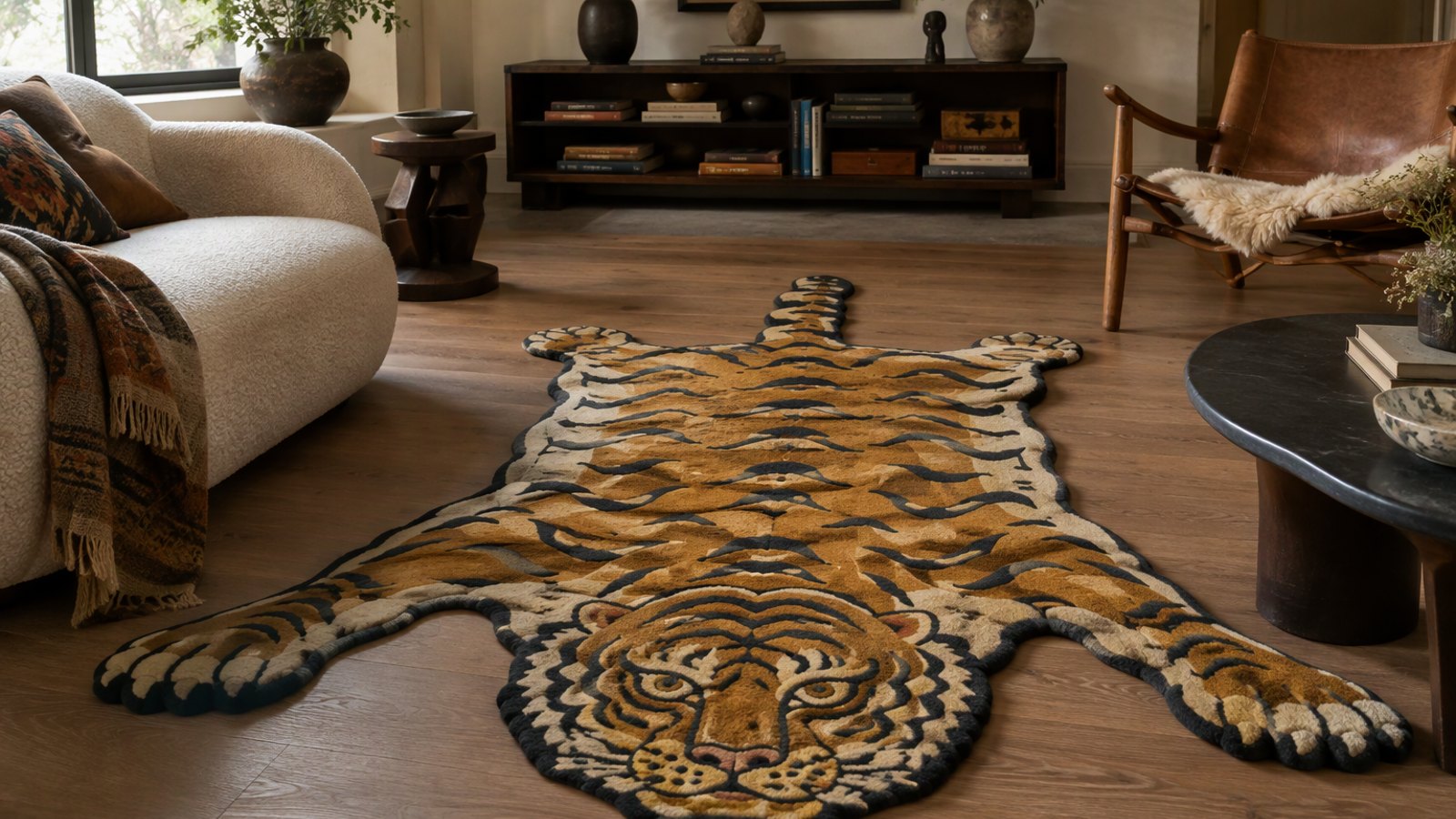
Tibetan Tiger Rug: Meaning, Design and How Seraj Weaves It

In short
- The tiger stood for protection, power and fearlessness, and tiger rugs were long used as seats and meditation mats in Tibetan monasteries.
- Designs range from full pelt layouts to bold stripes and abstract patterns, in both traditional and modern palettes.
- We weave the tiger with the Tibetan knot, hand-knotted from highland wool on our own looms in Nepal and India.
- Every tibetan tiger rug starts with a strike-off you approve, in your size, pattern and palette.
What a tibetan tiger rug means
A tibetan tiger rug carries meaning before it carries pattern. In the Himalayan tradition the tiger stands for power, protection and fearlessness, and the rug was treated as more than a floor covering. Many old examples were made as seats and meditation mats for monks and lamas, where the tiger under the sitter was understood to guard against harm and to steady the mind. That is why the tiger appears again and again in a region that had few tigers of its own: the animal was a symbol first, carried in through Buddhist and tantric imagery, and the rug was the object that kept it close at hand.
Because the tiger meant something, weavers gave it room. Unlike the dense borders and medallions of many traditional carpets, a tiger rug usually lets a single creature fill the field, stretched out, prowling or reduced to its pelt. That focus on one bold figure is part of what makes the design read as modern even though it is centuries old. If you want the wider family these pieces belong to, our guide to Tibetan rugs covers the construction and wool in more depth.
Tiger pelts, stripes and abstract tibetan rug patterns
Most tiger designs trace back to the look of a real tiger pelt laid flat, which is why so many of them are wider than they are tall and show a head, a body and a tail rather than a repeating motif. From that starting point weavers developed a few clear families of tibetan rug patterns:
- Pelt or whole-tiger layouts. The full animal spread across the field, often with a frontal face, four paws and a curling tail. This is the most literal and the most dramatic.
- Stripe-only designs. The tiger reduced to its stripes alone, running across the rug in waves. These abstract pieces feel contemporary and sit well in plain, modern rooms.
- Faced and geometric tigers. A stylized mask or a blocky, almost cubist tiger, where the stripes turn into rhythm and pattern more than anatomy.
Traditional palettes lean on gold, ochre and rust with black or charcoal stripes, but the design takes color changes well. We have woven quiet, tonal versions and high-contrast ones, and the same drawing can be reworked into softer or bolder tibetan rug designs without losing the animal at its center.
A short history of the tiger rug
Tiger rugs were woven across the Tibetan cultural world for generations, mostly for monastic and ceremonial use rather than for export. For a long time they were little known outside the region. That changed in the later twentieth century, when collectors and scholars began to document them and a wave of exhibitions and books put the tiger rug in front of a wide audience for the first time. Their bold, almost painterly figures struck people as surprisingly close to modern art, and the design moved from temple floors into galleries and homes.
Today the tiger sits in both camps at once. It is a genuinely old motif with a clear spiritual meaning, and it is also one of the most collectible and design-forward patterns a weaver can make. We treat it with that double respect: faithful to how the tiger was built and used, and open to the color and scale a modern interior calls for.
See the tiger on the loom
Contact usHow we weave it: the tibetan knot rug method
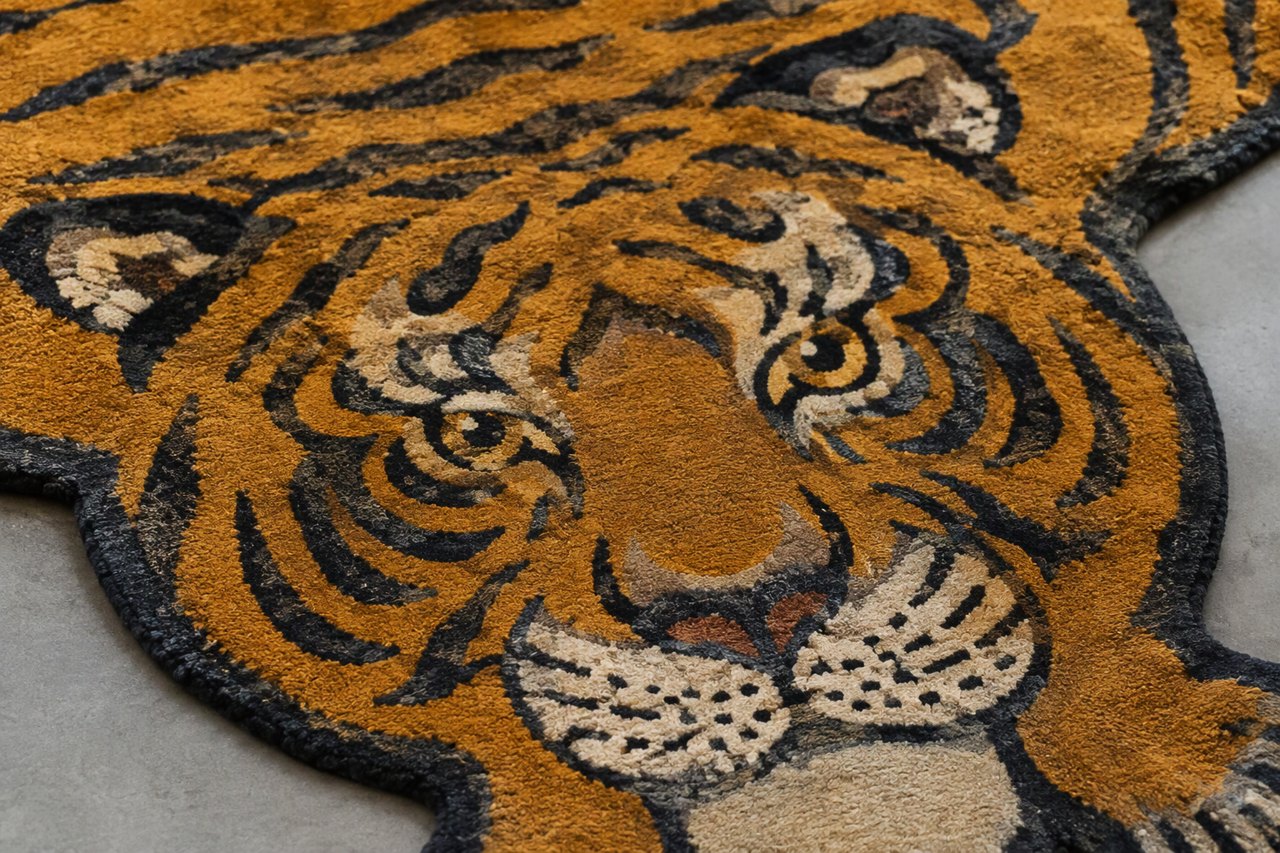
A true tibetan knot rug is not printed or glued. It is hand-knotted with the Tibetan knot, which is tied around a rod laid across the warps rather than knot by knot around each warp. When the row is finished the rod is cut free, leaving an even row of loops or cut pile. That method lets a weaver set knot density and pile height with real control, which matters for a tiger: the stripes need clean edges, and the face needs enough resolution to read.
This knot is the heart of what we do. Our founder, Shahid Ali Shah, brought the Tibetan knot to India, and the same method still runs on our looms today. With roughly 200 looms and 500 weavers across Nepal and India, we can route a tiger rug to the loom and knot count that suit the design, whether that is a bold pelt at a medium count or a finer, more detailed face. Because we are the maker, the rug you approve is the rug we weave, with no trading desk in between. You can see the related construction on our hand knotted wool rugs page.
The wool behind a tibetan hand knotted rug
The fiber does as much work as the pattern. A tibetan hand knotted rug is usually made from hand-carded highland wool, chosen for its luster, its spring underfoot and its long life. That wool is what gives the tiger its glow: the gold and rust tones read as warm and deep rather than flat, and the pile wears slowly and evenly over years of use. Where a design calls for extra sheen or fine detail we can blend in silk or lift the knot count, but wool stays the backbone of the piece.
Highland wool also takes dye in a way that suits this motif. The slow, living variation across a hand-knotted field, often called abrash, keeps a large single-color area from looking dead, so the tiger's body and the ground around it stay alive to the eye. Our rugs are woven in the Himalayan tradition on our own looms in Nepal and India; our guide to Nepal handmade rugs walks through that side of the work.
Tibetan rug designs we weave to order
Most of the tigers we make are woven to order, because a rug this graphic should fit the room it lands in. Partners come to us with a scale, a palette and a level of abstraction, and we build the tibetan rug designs around that brief. You can start from a classic pelt, a stripe field or a geometric face, and we will adjust the size, the colorway and the knot count to match.
Every custom order runs the same way. You send a size and a reference or a render, we return a strike-off, which is a woven sample in your exact colors and quality, and only once you sign off do we weave the full rug on our own looms. Browse our hand-knotted collection and our traditional rugs for a sense of what the knot can do, then send us a brief through custom rugs or reach the workshop directly.
Frequently asked questions
What does a tibetan tiger rug symbolize?+
Why are so many Tibetan tiger rugs based on a tiger pelt?+
What is a Tibetan knot rug?+
What wool do you use for a tibetan hand knotted rug?+
Can I order a tiger rug in a custom size and color?+
Where do you weave your Tibetan tiger rugs?+
Related guides and pages
See the tiger on the loom
Talk through your size, pattern and palette with the people who weave it in our Nepal workshop. We will return a strike-off in your exact colors before anything goes into production.
Contact us